
How to Open a Nail Salon in the UK 2026: Costs, Requirements & Checklist!

Kessy Williams – Last updated: 19 Mai 2026
Software for Nail Salons – 10-minute read
The most important facts at a glance
✓
Opening a nail salon in the UK requires no mandatory qualification. A local council licence (£250–£450) is the key legal requirement.
✓
Realistic startup costs range from £5,000 to £20,000+, depending on location, size and fit-out.
✓
The UK nail industry generates over £277 million per year and continues to grow steadily.
✓
Nail salons that use online booking and automated appointment reminders from day one earn more, waste less time, and lose far fewer clients to no-shows.
Dreaming of opening your own nail salon in the UK? You are not alone. The nail industry is one of the fastest-growing segments of the UK beauty sector, and with over 3,500 nail salons already trading across the country, the demand is clearly there. At the same time, many new nail businesses close within their first two years. Not because of a lack of talent, but because of poor planning, underestimated costs and disorganised day-to-day operations.
This guide gives you an honest, complete picture of what it really takes to open a nail salon in the UK in 2026. From legal requirements and startup costs to the tools that keep your calendar full and your revenue growing from day one.
Is it worth opening a nail salon in the UK in 2026?
Short answer: Yes, but only with a solid plan.
The UK nail industry generated £277.4 million in revenue in 2023, and the market has continued to grow since. Nail technicians and salon owners in the UK earn on average £33,947 and £50,000 per year respectively, according to 2026 data. The demand for nail services, from classic manicures to BIAB and nail art, shows no sign of slowing down.
The challenge is competition. With thousands of nail salons across the UK, standing out requires a clear concept, a professional setup from day one, and smart use of digital tools to attract and retain clients.
What does a realistic monthly income look like?
A solo nail technician fully booked at 5 clients per day, 5 days a week, at an average service price of £35 can generate around £3,500 in monthly revenue. The key word is “fully booked.” Salons that offer online booking, where clients can schedule appointments 24/7 without needing to call, fill their calendars faster and more consistently than those relying on phone calls and WhatsApp messages. After costs, a well-organised solo operator can expect a net income of £1,800 to £2,500 per month in the first year, rising significantly as the client base grows.
Legal Requirements Overview
Requirement
Mandatory
Cost
Local council licence
Yes
£250–£450/year
Business registration (HMRC/Companies House)
Yes
Free (sole trader)
Public liability insurance
Strongly recommended
From £250/year
Professional indemnity insurance
Strongly recommended
Included in most beauty policies
Employer’s liability insurance
Yes (if you hire staff)
From £500/year
NVQ/Level 2–3 qualification
Not legally required
£300–£1,500 (course fees)


How much does it cost to open a nail salon in the UK?
Startup costs vary widely. A home-based setup can be launched for under £5,000. A professional high street salon in a city centre can easily exceed £20,000 before you take your first booking.
Startup Cost Breakdown
Cost Item
Minimum
Realistic
Council licence
£250
£450
Business registration
£0
£50
Premises deposit (3 months rent)
£0 (home studio)
£3,000–£6,000
Fit-out and decoration
£500
£5,000–£15,000
Manicure stations and chairs
£800
£2,500
UV lamps and nail dryers
£200
£600
Starter stock and products
£400
£1,500
Sanitation equipment
£150
£400
Insurance (first year)
£250
£800
Website and online presence
£0 (DIY)
£500
3-month cash reserve
£1,500
£3,000
Total
£4,050
£20,000+

What most people underestimate: running costs begin from day one, long before a steady client base is established. A minimum three-month cash reserve is not optional. It is essential.
7 steps to opening your nail salon in the UK
Step 1: Define your concept and positioning
Before signing any lease or placing any orders, answer these three questions clearly:
– Who is your ideal client? (Students, professionals, luxury market, families?)
– What makes your salon different? (Vegan products, nail art specialism, premium experience, convenience?)
– Are you working alone or building a team from the start?
The UK nail market is competitive. A salon without a clear identity blends into the background. The ones that build loyal followings from day one, whether through a signature aesthetic, a specialist service like BIAB or Russian manicure, or simply outstanding customer care, are the ones that succeed.
Step 2: Choose your location carefully
Location is arguably the single most important decision you will make. High foot traffic areas such as high streets, shopping centres, offices and residential neighbourhoods give you passive visibility from the start. A quieter location requires more active marketing to compensate.
What to check before committing: How many competing salons are within a 10-minute walk? What is the average footfall in the area? Does the space have adequate ventilation for nail product fumes, which is a legal hygiene requirement?
Step 3: Write a business plan
A business plan is not just a document for bank loans. It forces you to think through your pricing, costs, break-even point and growth strategy in concrete terms.
Key numbers to calculate: If your fixed annual costs are £20,000 and your average service costs £5 in supplies, you need roughly 1,250 services per year at £35 per service to break even. That is around 24 services per week, which is very achievable for a single technician working full time, especially when clients can book themselves online around the clock rather than waiting for you to pick up the phone.
Funding options available in the UK:
– Start Up Loans (government-backed, up to £25,000 at 6% fixed interest)
– Prince’s Trust Enterprise Programme (for under-30s)
– Local authority small business grants
Step 4: Register your business and get licensed
Register as self-employed with HMRC or form a limited company via Companies House. Then apply for your local council licence. Contact your council directly as requirements vary by area.
Tax tip: If your expected annual turnover in year one is below £90,000, you do not need to register for VAT. This simplifies your bookkeeping significantly in the early stages.
Step 5: Set up your premises and meet hygiene standards
UK councils take hygiene compliance seriously and will inspect your premises. Key requirements include proper ventilation, sterilisation of all tools between clients, clean separation of used and unused instruments, and accessible hand sanitisation for clients.
Getting this right from the start avoids costly remediation later.
Step 6: Build your online presence
The number one reason new salons struggle to fill their calendar is simple: they are invisible online.
A Google Business Profile is free, takes 30 minutes to set up, and is the single most effective action you can take to attract local clients. When someone searches “nail salon near me” in your area, a verified profile with photos and reviews puts you directly in front of them. Better still, connect it to an online booking system so that clients can book an appointment instantly from Google, with no phone call needed and no back-and-forth message thread.
Add to this an Instagram profile where you post your work regularly. Nail services are inherently visual. A well-curated feed is your free shop window to thousands of potential clients. The salons that grow fastest on Instagram are the ones that have a booking link in their bio, so interest converts into confirmed appointments immediately.
Step 7: Set up your appointment system from day one
This is the step most new salon owners delay, and later wish they had not.
Many nail salons start with WhatsApp and a paper diary. It works for the first ten clients. After that, problems start. Double bookings happen. Cancellations get lost in message threads. Clients forget their appointments. You spend every evening chasing confirmations instead of resting.
The impact on revenue is real and measurable. A no-show at a £35 service is £35 lost, and that slot cannot be filled at short notice. Five no-shows per month is £175 gone. Over a year, £2,100. Salons that send automated appointment reminders via SMS and email reduce no-shows by up to 70%, because a reminder sent 24 hours before gives clients the chance to cancel in time for you to rebook that slot.
Beyond no-shows, a proper appointment system means clients can book online 24/7, you receive instant notifications, and you have a digital client record for every person who visits, including their service history, preferences and contact details. That information turns a one-time visitor into a returning client.
An online booking and appointment management system like Calendall covers all of this from £21 per month (from £19 without online booking). For most salons, recovering just one no-show per month more than covers the entire cost.

Paper diary vs. online booking software: An honest comparison
Paper Diary
Online Booking Software
No-show risk
High no-show rate
Reduced by up to 70%
Digital client records
Manual (paper records)
Digital client records, searchable and accessible anytime
Daily admin time
1–2 hours
Under 15 minutes

Why online booking directly increases your revenue:
When clients can book at any time, including late at night when they are scrolling through Instagram, you capture appointments you would otherwise lose. A client who cannot reach you by phone does not always call back. A client who taps your booking link and confirms in 30 seconds almost always shows up.
Add automated reminders and digital client records, and you have a system that not only fills your calendar but actively retains clients by making their experience feel professional and effortless from the very first interaction.
Frequently asked questions: Opening a nail salon in the UK
1. Can I open a nail salon from home in the UK?
Yes. A home-based nail salon is a popular starting point as it eliminates premises costs. You will still need a council licence, your space must meet hygiene standards, and you should check whether your tenancy or mortgage agreement permits commercial use. An online booking system works just as well for a home studio as for a high street salon. Clients book, receive automatic reminders, and arrive on time regardless of where you are based.
2. Do I need a qualification to open a nail salon in the UK?
No formal qualification is legally required. However, most insurance providers require evidence of relevant training, and clients expect it. A Level 2 or Level 3 Certificate in Nail Technology is the standard and widely available at further education colleges.
3. How much can a nail salon owner earn in the UK?
According to 2026 data, nail salon owners in the UK earn on average £50,000 per year. Solo operators who are well-organised, with a full calendar, professional online booking, and strong client retention through automated reminders, can reach this level within two to three years of opening.
4. How long does it take to become profitable?
Most nail salons reach break-even within 6 to 12 months. Those that use online booking and appointment reminders from the start tend to build their client base faster, because booking is frictionless and no-shows are significantly reduced.
5. What are the most common reasons nail salons fail?
Insufficient cash reserves, no clear market positioning, and chaotic appointment management. These three factors account for the majority of early closures. The third one is the easiest to solve, and the most consistently overlooked.
Checklist: Opening a nail salon in the UK
Before opening
□ Business concept and unique selling point defined
□ Target client clearly identified
□ Business plan written with break-even calculations
□ Funding and cash reserves secured (minimum 3 months of running costs)
□ Location chosen and lease reviewed
□ Business registered with HMRC or Companies House
□ Local council licence applied for and approved
□ Public liability and professional indemnity insurance in place
□ Employer’s liability insurance (if hiring staff)
□ Premises meet ventilation and hygiene requirements
□ Equipment and starter stock orderedBusiness concept and unique selling point defined
□ Target client clearly identified
□ Business plan written with break-even calculations
□ Funding and cash reserves secured (minimum 3 months of running costs)
□ Location chosen and lease reviewed
□ Business registered with HMRC or Companies House
□ Local council licence applied for and approved
□ Public liability and professional indemnity insurance in place
□ Employer’s liability insurance (if hiring staff)
□ Premises meet ventilation and hygiene requirements
□ Equipment and starter stock ordered
Ready to launch
□ Google Business Profile created, verified and connected to online booking
□ Instagram profile set up with booking link in bio
□ Website or booking page live
□ Online booking software configured (Calendall offers a 14-day free trial, no card required)
□ Digital client records system active
□ Automatic SMS and email appointment reminders switched on
□ Price list finalised and visible online
□ First reviews collected from friends and practice clients
Conclusion: What separates the salons that last from the ones that don’t
Opening a nail salon in the UK in 2026 is entirely achievable. The market is growing, the legal barriers are manageable, and the demand for nail services is strong and consistent. The salons that struggle are almost never the ones with the least talent. They are the ones that ran out of cash, had no clear identity, or lost clients one by one to forgotten appointments and missed booking requests.
The salons that build lasting businesses do three things well from the beginning: they know exactly who they are serving, they are easy to find and book online, and they have a system that handles the admin so they can focus entirely on the work.
Online booking, automated appointment reminders, and digital client records are not luxuries for an established salon. They are the foundation that allows a new salon to grow faster, retain clients longer, and earn more from the same number of working hours.
Calendall was built for exactly this: small beauty businesses that want to run professionally from day one without paying enterprise prices. Online booking, client records, SMS and email reminders, and a clean appointment calendar, all in one place, from £19 per month.
Start your free 14-day trial, no credit card required.
Similar articles about nail salons
BLOG: SOFTWARE FOR NAIL SALONS – 10 MIN. READ
The best nail salon appointment software in the UK – Top 5 providers compared 2026
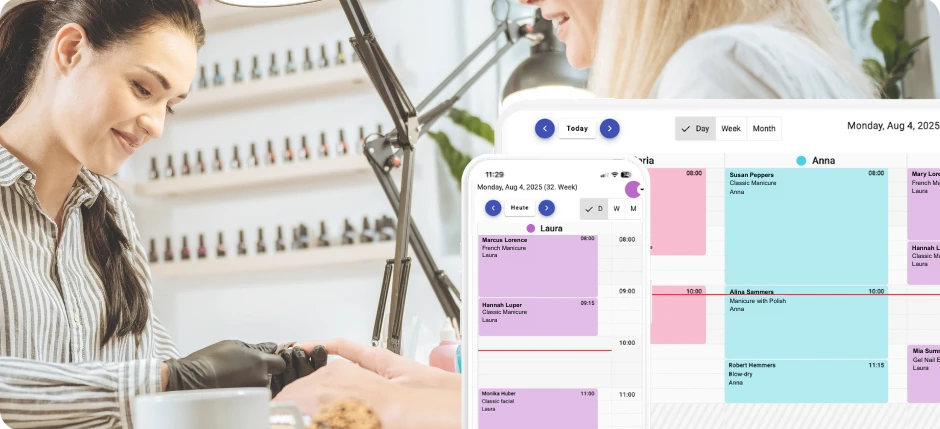
The salon is fully booked, your next client is waiting, and at the same time the phone rings – someone wants to book an appointment. If you run a nail salon, you know the situation: between treatments, client care, and admin, time is always your most limited resource…
BLOG: SOFTWARE FOR NAIL SALONS – 11 MIN. READ
Nail salon appointment software to grow your beauty business in 2026

Running a nail salon means managing a busy schedule every day. Modern nail salon booking and scheduling software helps organise appointments, reduce no-shows and allow clients to book online at any time. In 2026, many clients expect fast and convenient online booking…
BLOG: SOFTWARE FOR NAIL SALONS – 12 MIN. READ
Best nail salon appointment software for Small businesses: Features, pricing & tips (2026)

Running a nail salon has become more time-consuming in recent years. Phone bookings, manual diaries and last-minute changes interrupt daily operations and reduce productivity. In 2026, more nail salons are switching to online booking software to reduce phone time and…


